Getting Started
How to open Mosaic, find your way around it, make your first map, and know what you can do there.
Overview
Mosaic, at mosaic.toflourish.org, is where your organization makes maps of its data and shares them. A map is made of layers: points, such as sites or clients, and regions, such as ZIP codes or counties. Layers come from your organization's Salesforce, from files you upload, and from public data built into the map, such as Census boundaries and CDC health measures.
Your organization switches Mosaic on in the Flourish Dashboard. See Solutions. Its admins then choose who makes maps. See People and Roles.
Mosaic works on a phone as well as a computer. On a phone, the menu button at the top opens the sidebar.
Opening Mosaic
There are two ways in:
- In the Flourish Dashboard, open Solutions and choose Open on Mosaic's card. Mosaic opens in a new tab.
- Go to mosaic.toflourish.org.
You sign in on Flourish's sign-in page, the one every Flourish app uses. If you've signed in to a Flourish app in this browser before, you choose your account from its list. How signing in works is on the Flourish Dashboard's Getting Started.
After you sign in, Mosaic opens your organization. If you belong to more than one, Your organizations lists them, and you choose one. An organization whose Mosaic is switched off shows Not active right now and doesn't open.
If Mosaic says You aren't part of an organization in Mosaic yet, ask your organization's admin to add the email address you signed in with. If you signed in with the wrong account, choose Use another account.
Each organization's address is its own, so you can work in two organizations in two tabs. A map has an address of its own, too, so you can send it to someone in your organization who can open it.
Someone you share a map with by its link doesn't sign in at all. See The link.
Signing out
Choose your name at the bottom of the sidebar, then Sign out. It signs you out of every Flourish app in this browser.
Home
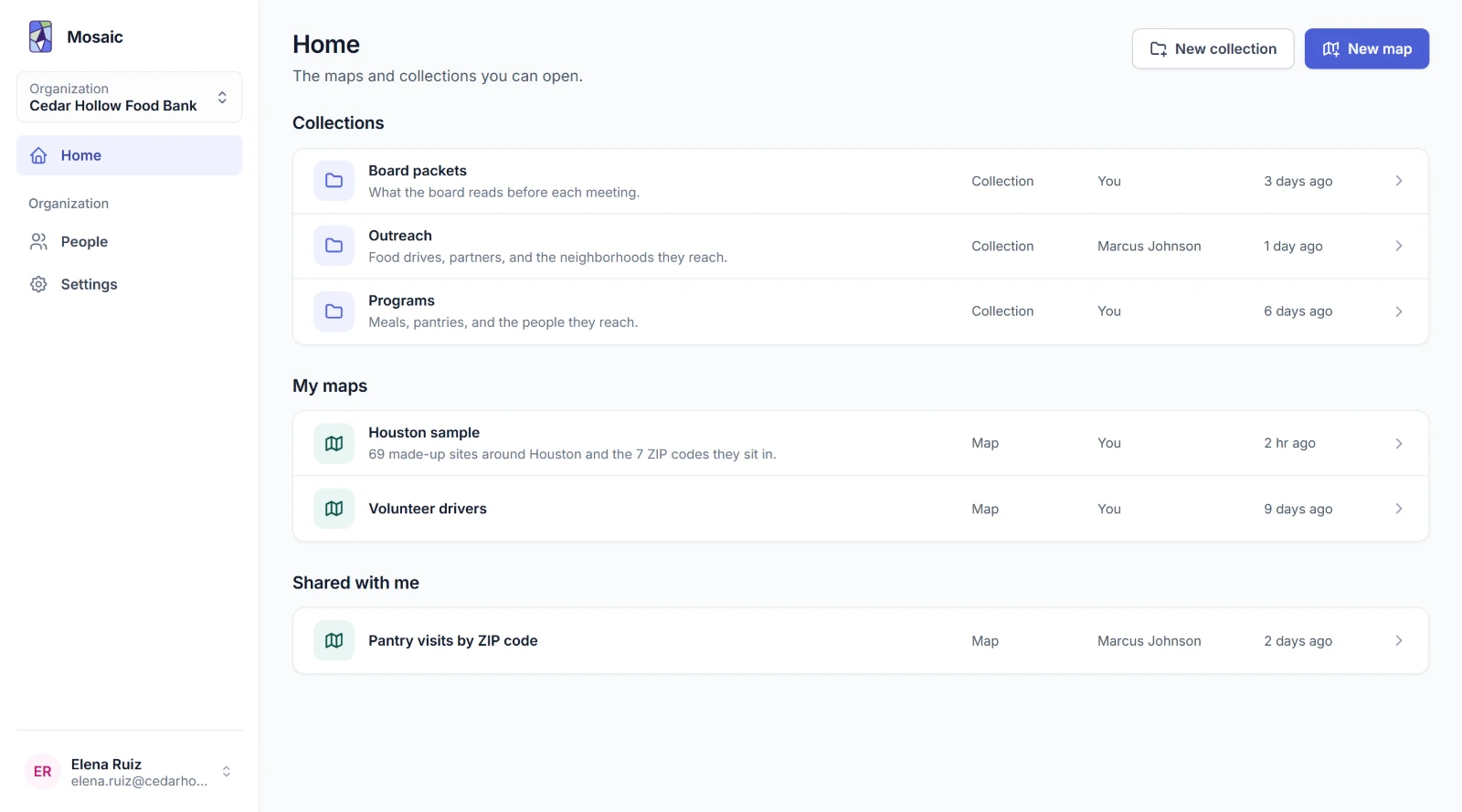
Home is the first page of an organization. It lists the maps and collections you can open.
| Section | What it lists |
|---|---|
| Collections | The collections you can open. A collection holds maps and other collections. See Collections and Sharing. |
| My maps | Your own maps that aren't in a collection. |
| Shared with me | Maps someone shared with you directly. |
Each row shows what kind of item it is, who owns it (You for your own), and when it last changed. Choose a row to open it.
If you make maps, New collection and New map sit at the top. A map you make here starts in My maps, where only you can see it until you share it.
The sidebar
| Item | What it's for |
|---|---|
| Organization, at the top | The organization you're in. Choose it to switch to another one or to go to All organizations. |
| Home | Your maps and collections. |
| People | Who is in the organization and who makes maps. See People and Roles. |
| Settings | The organization's settings, its sources, and its address lookups. See Sources and Settings. |
| Your name, at the bottom | Your email address and Sign out. |
Making a map
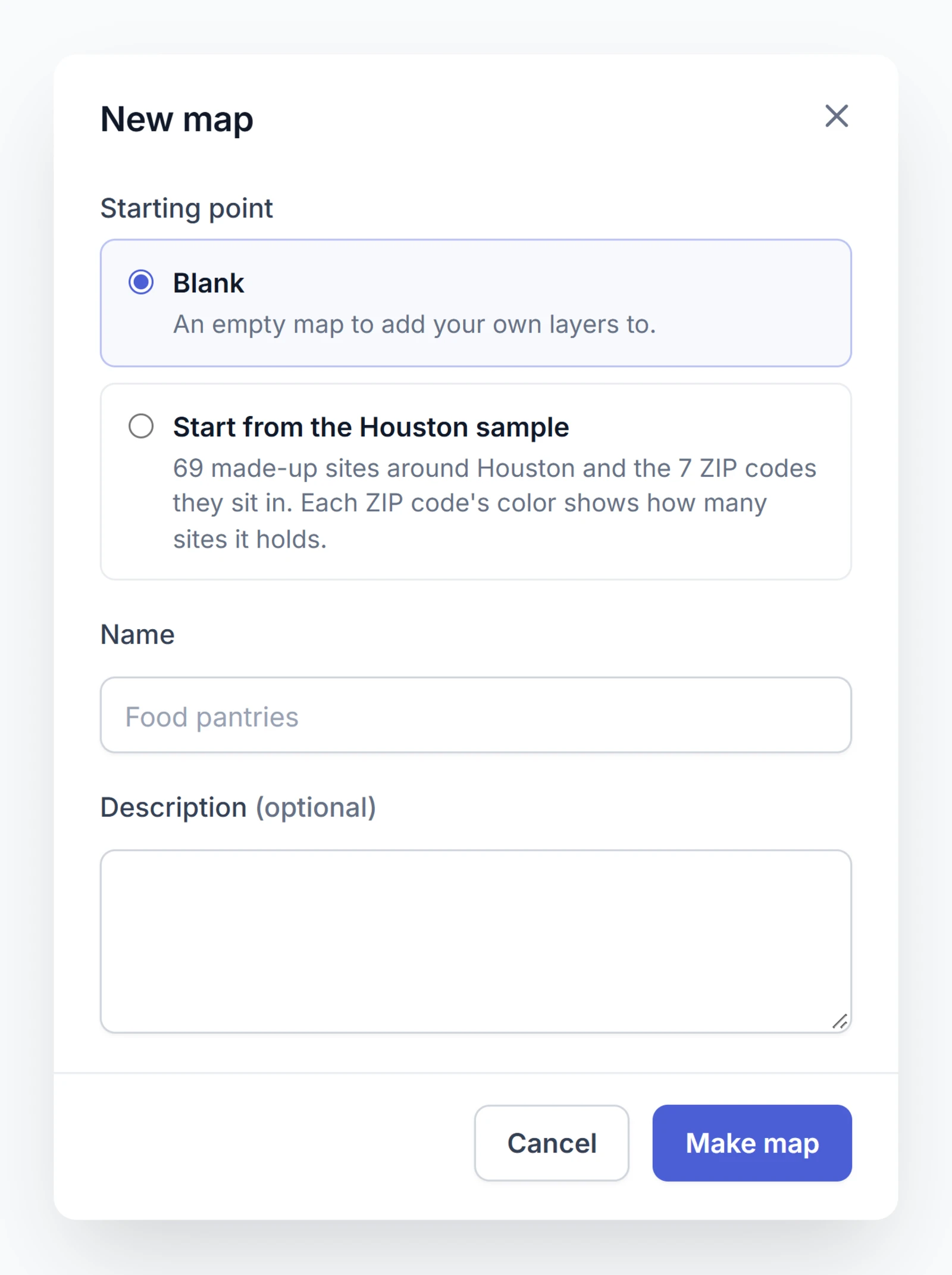
- On Home, choose New map. Inside a collection, New map makes the map in that collection.
- Choose a Starting point:
- Blank is an empty map to add your own layers to.
- Start from the Houston sample gives you a working map before you connect anything: 69 made-up sites around Houston and the 7 ZIP codes they sit in, each ZIP code colored by how many sites it holds.
- Give it a Name and, if you like, a Description.
- Choose Make map.
The map opens on its own page. To fill it, see Adding Data. To find your way around it, see Exploring Maps.
What you can do
What you can do in Mosaic depends on your role in the organization.
| Role | Can |
|---|---|
| No role | Open what's shared with them. |
| Creator | Make maps and collections, change the ones they can edit, and share them. |
| Admin | Add people, choose who makes maps, turn sources on and off, and change the organization's settings. |
Admins don't make maps unless they also hold the creator role. An admin without it sees Make maps yourself on Home and can give themselves the role in one click.
Each map and collection is shared with people to view it or to edit it. Someone who can view a map can still explore it in every way that changes nothing for anyone else: showing and hiding layers, filtering, searching, and playing back a time series. See Exploring Maps.